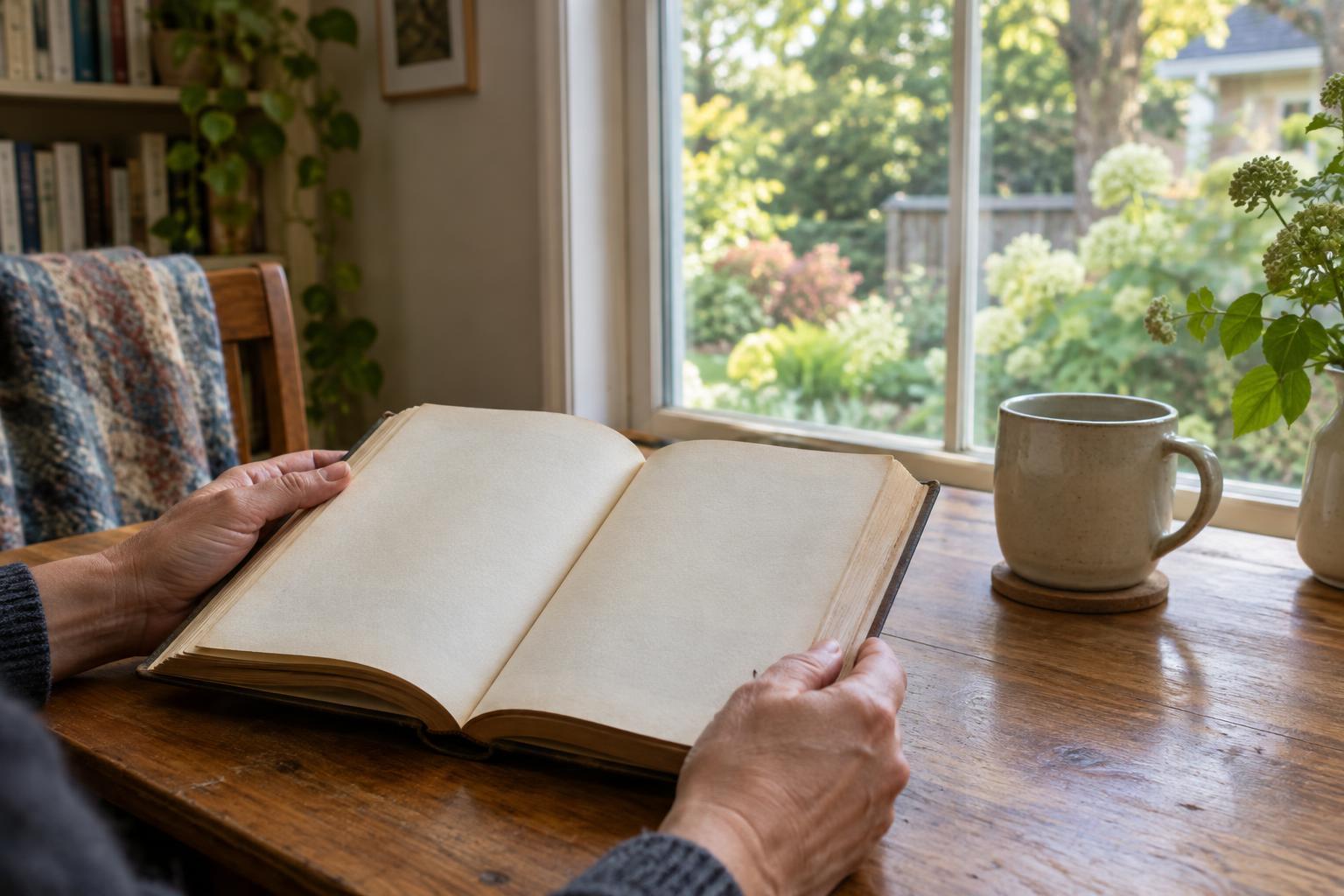
Begin with a page, not a performance
Reading aloud to yourself may feel unusual at first. Without an audience, though, there is no need to sound polished or expressive. You can stumble over a sentence, start again, or let your voice drop to a whisper. The aim is not to deliver the text well. It is to spend enough time with it to notice what it is doing.
Choose a short passage: a poem, a page of a story, a paragraph from an essay, or a familiar piece you have been meaning to revisit. Find a place where you can speak comfortably, and keep a pencil nearby if you like marking the page. Before you begin, look at the title and the shape of the text. Then read once at your ordinary pace. That first reading gives you something to compare with your next one; it does not need to reveal everything.
Let pace reveal the shape of a sentence
On a second reading, slow down just enough to hear where one thought turns into another. A comma may hold two ideas together, while a full stop may give one idea room to settle before the next arrives. You do not have to pause at every punctuation mark in the same way. Let the sense of the sentence guide you as much as the marks on the page.
Try reading one sentence twice. The first time, move through it steadily. The second time, give a little more space to a repeated word, a change in direction, or an image that catches your attention. Ask yourself what changed. Did a detail become more vivid? Did a gentle sentence begin to sound uneasy, or a complicated one become clearer? A slower pace is useful when it helps you hear a distinction, not when it turns every word into a separate event.
Speed has a place, too. A quick list or a run of short actions might carry a sense of bustle that disappears if you read it too carefully. After slowing down, try restoring the passage's momentum. Moving between paces can show you how its meaning depends on rhythm as well as vocabulary.
Make room for silence
Silence can be part of reading rather than a break from it. When you reach the end of a paragraph, wait for a breath before moving on. Instead of immediately explaining what you think, notice what remains in your mind: a question, a picture, a word, or perhaps a feeling you cannot yet name. You may find that the next paragraph answers it, complicates it, or leaves it open.
You can also pause within a passage when a sentence seems to ask for it. If a writer describes someone arriving at a doorway, for example, a brief silence before the door opens may help you notice the uncertainty of that moment. Try the same line without the pause. Neither version is necessarily correct; the comparison helps you hear your own interpretation.
If your mind wanders during a silence, there is no need to treat that as failure. Return to the last phrase you remember and read it again. The quiet is not a test of concentration. It is simply room for the words to linger before more words take their place.
Listen for what your voice resists
Some passages are harder to say than to scan with your eyes. You might rush past an unfamiliar phrase, flatten a change in tone, or lose track of who is speaking. Those moments are useful clues. Stop and look at the sentence without trying to fix it immediately. Where does the thought begin? Which word changes its direction? Does the difficulty come from the writing, or from an assumption you brought to it?
Reading aloud can also make disagreement easier to notice. A sentence may sound confident, yet you may not be convinced by it. Another may seem plain on the page but sound tender when spoken. You need not settle on a final judgment. Write a brief note such as “Why this word?” or “Read again” and keep going. Curiosity is often more helpful than forcing a quick conclusion.
Carry one line with you
To finish, choose one sentence or a few lines and read them a final time. Let your pace be natural now, informed by what you noticed rather than controlled by a rule. Then sit quietly for a moment. What do you understand more clearly? What remains uncertain? Both answers are worth keeping.
This small practice can fit into an ordinary day. You might read a paragraph before a gathering, return to a poem after a walk, or revisit a story someone in your neighborhood has recommended. If you later discuss the passage with others, you can share a line that stayed with you without needing to explain the whole work. Reading aloud alone offers a modest way to prepare for that kind of conversation: listen first, leave space, and allow meaning to arrive at its own pace.