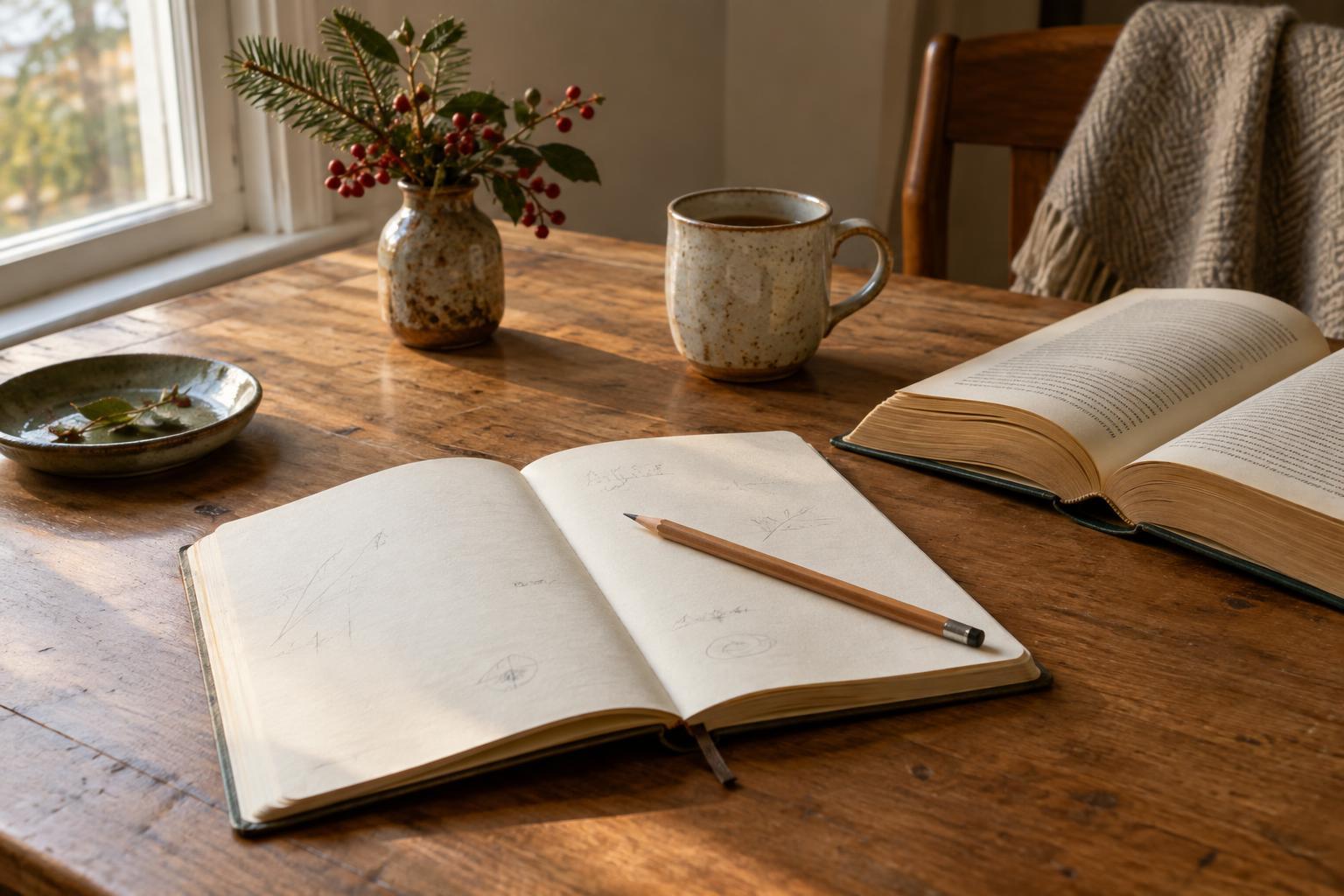
Two useful ways to read
If you open a neighborhood notice to find the time of a gathering, you are reading for information. You have a question, and the text may answer it directly. You might scan for a date, check an address and put the notice down. This kind of reading is useful: it helps us plan, learn and act.
Reflective reading begins with a different kind of attention. Instead of asking only, “What does this say?” you also ask, “What does this bring to mind?” A story might remind you of a conversation with a neighbor. An essay might unsettle an assumption you had not noticed. A poem might leave you with an image you want to sit with. The aim is not necessarily to reach a conclusion. It is to give a text, and your response to it, enough time to unfold.
The difference is in your purpose
The same page can support both kinds of reading. You could read an article about a community garden to learn when volunteers meet, then return to a description of people sharing a harvest because it makes you think about generosity. Neither approach is more worthy. What changes is the question you bring to the page and what you do when you find something that matters to you.
When reading for information, it often makes sense to move quickly, compare details and check that you have understood the main point. When reading reflectively, it can help to slow down, reread a passage or pause before moving on. You may notice a feeling without yet knowing why it arose. You may disagree with the writer and still find the disagreement worth exploring. Reflective reading does not require you to accept every idea you encounter; it invites you to pay attention to your own thinking as well as the text.
A simple way to begin
Choose something short enough that you will not feel rushed: a few pages of a book, a poem, a personal essay or even a familiar story. Read it once for its basic meaning. Then read a portion again and notice where your attention catches. It might be a sentence you admire, a choice someone makes or a detail you would usually pass over. You do not need to select a profound passage. Curiosity is enough.
Afterward, try writing a few plain sentences in response. You might finish one of these prompts: “This reminded me of…,” “I wonder why…,” or “I see this differently because….” If writing feels awkward, take a quiet walk or talk with a friend instead. The point is not to produce a polished interpretation. It is to make room between encountering the words and deciding what they mean to you.
Some days, a passage will offer a clear insight. On others, your response may be a question or a sense that you want to come back later. Both are reasonable outcomes. Reflective reading is a practice of attention, not a test with an answer key.
Making space for reflection together
Reading with others can widen your view of a text. In a neighborhood reading circle, one person may notice a moment of humor while another hears sadness in the same scene. Sharing those responses can be more welcoming than asking everyone to arrive at one interpretation. A useful opening question is, “What stayed with you?” It lets people begin with what they actually noticed.
Good conversation also leaves room to pass. Not everyone wants to share a personal memory, and no one needs to explain a feeling before they are ready. Listening without immediately correcting or solving can help participants explore an idea in their own words. When someone reads differently, you can ask what in the text led them there rather than treating the discussion as a contest.
There will still be times when you need a quick, reliable answer from what you read. Reflective reading does not replace that skill. It offers another way to spend time with words—one that can help an ordinary page become a starting point for thought, conversation and a closer look at everyday life.