Decide what the map is for
A welcome map does not need to show everything in a neighborhood. Its value comes from helping someone answer a few everyday questions: Where can I sit for a while? Where are the shared gathering places? How do I get to the library, a public notice board or a commonly used walking route? A focused purpose makes the map easier to create and more useful to read.
Begin by naming the people you hope to serve. A map for new residents might emphasize public places and ways to meet neighbors. One made for a community event might show entrances, seating, restrooms and transit stops. Write a short statement of purpose before collecting suggestions, then use it to decide what belongs on the finished map.
Keep the project manageable. Choose a clear geographic boundary and a modest number of places to feature. If the area is large, make one small map first rather than trying to cover every street. That first version can reveal which details people actually need.
Invite residents to shape what appears
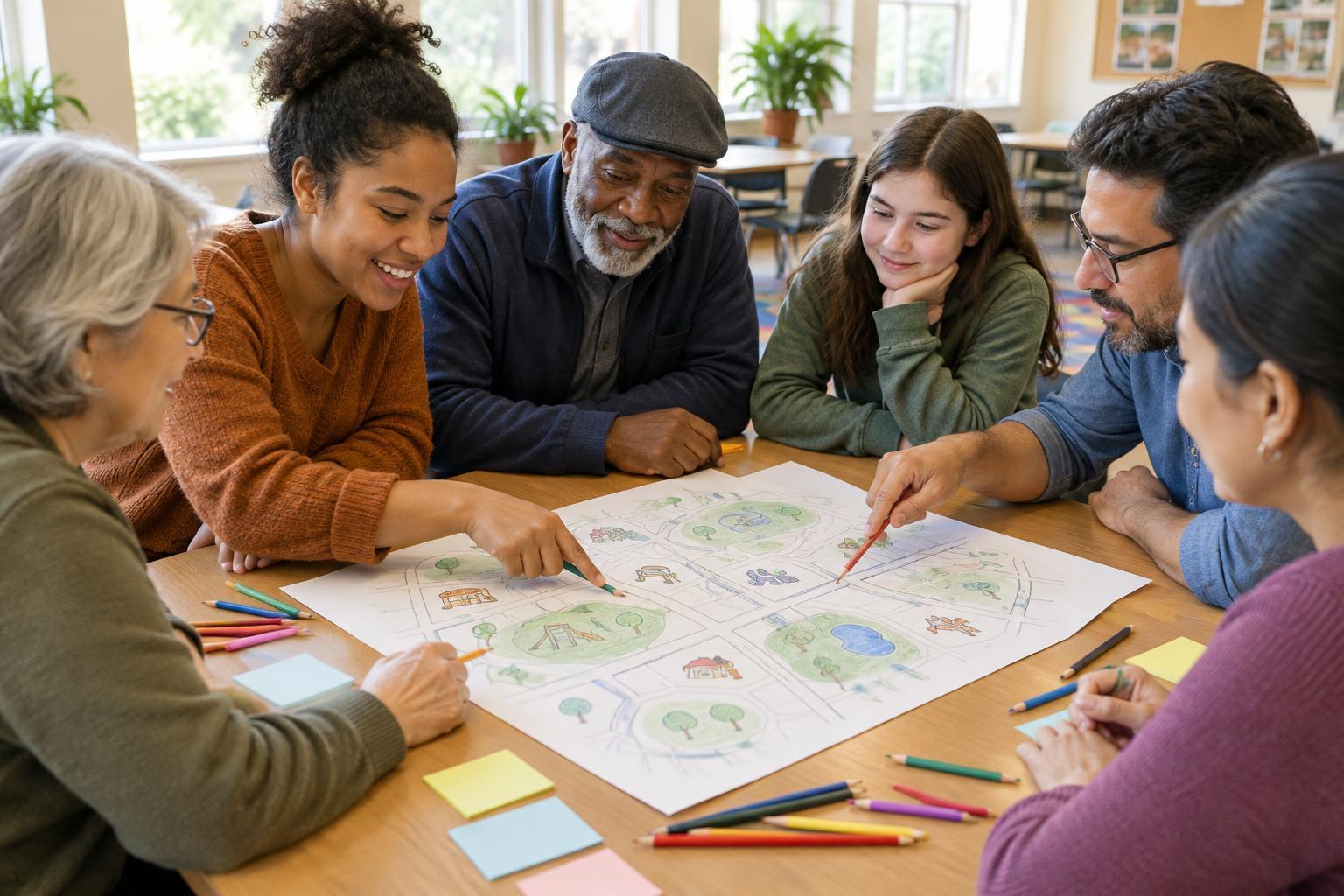
Ask a range of neighbors what they would have wanted to know when they first arrived. A short paper form, a conversation at a gathering or a table at a shared space may bring different responses. Ask specific questions, such as which public places are easy to overlook, where directions are confusing and what information would help someone feel comfortable visiting.
Treat suggestions as starting points, not automatic entries. One person’s favorite shortcut may cross private property; a welcoming-looking room may be open only at certain times. Check whether a place is public, whether it can reasonably be shown on a map and whether its name and entrance are clear. Avoid marking private homes or sharing personal contact details without explicit permission.
Pay attention to whose experience may be missing. Someone who travels without a car may suggest different landmarks from someone who drives. A parent with a stroller or a neighbor who uses a mobility aid may notice barriers others miss. You cannot promise that every route or location will work for everyone, but you can avoid presenting unverified assumptions as guarantees.
Make the map easy to read and use
A simple map with a few well-chosen labels often works better than a crowded one. Use familiar street names, a clear orientation and a key for any symbols. If you include a walking route, identify its start and end rather than relying on a colored line alone. Brief descriptions can explain why a place matters: “public seating” is more helpful to a newcomer than a name with no context.
Try a draft with people who did not help make it. Ask them to locate two or three places, then watch where they hesitate. Check the map at the size it will actually be printed or viewed. Small text and similar-looking symbols may seem fine on a large screen but become difficult to distinguish on a handout. A text list of featured locations can also help people who find a visual map hard to use.
Photographs and illustrations can make a welcome map inviting, but they should clarify rather than decorate. Choose images that match what visitors will encounter, and get permission before using identifiable pictures of people. For more ideas on thinking carefully about how visuals shape a reader’s understanding, browse Media Literacy · The Visual Story Journal.
Plan for changes before sharing it widely
Even a small map can become misleading when entrances move, gathering places change their hours or a listed feature is removed. Before distributing it, decide who will receive corrections and how often someone can review the details. Keep an editable original and a short record of what was checked, so the next volunteer does not have to rebuild the map from memory.
Choose distribution methods that fit the people you want to reach. Printed copies might be available at a gathering or a community notice board; a digital copy may be convenient for sharing. Neither format reaches everyone, so consider offering both if your team has the capacity. If a host agrees to display copies, ask where they can go and who will replenish them.
Finally, leave room for the map to grow without expecting it to become a complete directory. Invite corrections in a way residents can use, and be willing to remove an entry that proves confusing or unsuitable. A welcome map succeeds when it helps someone take a first step into neighborhood life—not when it captures every detail of it.