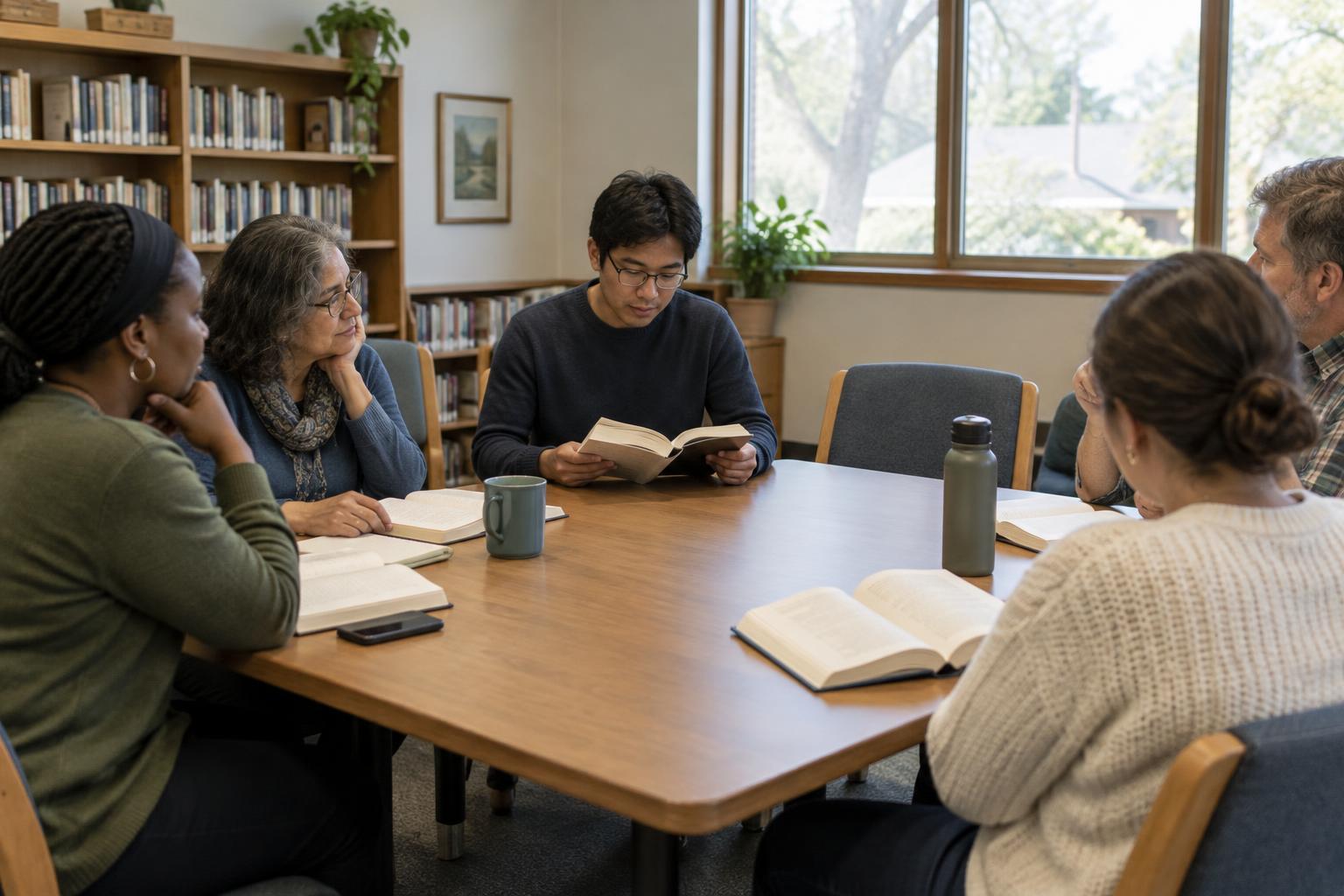
Set expectations before the reading begins
A difficult passage may raise questions about harm, loss, injustice, belief, or belonging. People bring different histories to those words, but a group does not need to know those histories in order to read with care. Before beginning, a facilitator can say plainly that discussion will focus on the passage and that no one will be asked to explain why it matters to them personally. Speaking, listening, and passing are all welcome ways to participate.
It helps to describe the format as well as the intention. Tell readers how long the discussion will last, whether they will have a quiet moment to read first, and how turns will work. If the passage is known to contain potentially upsetting material, describe that material briefly and without drama so people can decide how they want to take part. Someone may choose to step out or simply listen; neither choice requires an explanation.
Keep the first questions close to the page
A question such as “Has this ever happened to you?” moves quickly from reading into disclosure. Begin instead with observations anyone can make: “Which phrase seems central?” “Whose perspective do we hear?” “What is left unexplained?” These questions give the group something shared to examine. They also leave room for a person to speak thoughtfully without revealing anything about their life.
As the conversation develops, invite interpretations rather than confessions. Readers might consider how the passage creates tension, what assumptions a character makes, or why two people could understand the same sentence differently. In a group reading a spiritual text, participants may hold different relationships to its teachings. Asking what the words say and how they might be understood makes space for those differences without requiring anyone to state a personal belief.
Offer more than one way to participate
Open discussion favors people who are comfortable speaking quickly. A short pause after each question gives everyone time to think. You might also offer a few minutes to jot down observations, followed by an invitation to share one idea if desired. Writing can remain private; it should not become something participants are expected to read aloud or hand in.
When inviting responses, make passing ordinary rather than exceptional. A facilitator might say, “We can go around for one observation each, and passing is always fine.” Avoid returning later to someone who passed unless they volunteer. If a person offers a brief answer, accept it as complete. Follow-up questions can be useful when someone wants to explore an idea, but they should not be used to draw out the story behind it.
Respond with care when someone does share
Even with clear boundaries, someone may connect a passage to a personal experience. Thank them for what they chose to offer without asking for further details. Then give the group a way back to the shared reading: “That draws attention to the silence in this paragraph. What else do we notice there?” This acknowledges the contribution without making one person’s experience the subject of the meeting.
A facilitator can also interrupt gently if others begin to diagnose, advise, debate, or question the speaker. A simple reminder—“Let’s not ask anyone to explain more than they want to”—protects the choice to share only a little. Encourage participants not to repeat personal details outside the group, while avoiding promises of confidentiality that no group can fully guarantee.
Close without forcing agreement
Difficult passages do not always lead to a neat conclusion. Near the end, ask what questions remain or what idea participants want to keep considering. Make it possible to answer in general terms: “I’m still thinking about the narrator’s choice” is enough. No one needs to say that they feel changed, comforted, or persuaded.
Thank people for the attention they gave the reading, including those who listened quietly. If the conversation was heavy, allow a moment of silence before moving on to ordinary conversation or the next activity. The goal is not to make every reader feel the same way. It is to create a setting where the passage can be examined honestly and each person retains control over their own story.